7 AI Call Misconceptions Holding Back Enterprise Transformation
AI voice agents are revolutionizing how organizations handle customer communications, yet certain misconceptions persist that prevent many enterprises from realizing substantial operational gains they are currently missing out on. Deloitte recently cited that up to 79% of contact center leaders are actively planning to expand their AI capabilities in the coming years, so outdated assumptions about AI call technology shouldn't continue to delay implementation that ultimately limits savings and efficiency boosts for many organizations.
In today's regulatory environment, data security has become a board-level concern for enterprises. Security considerations often represent the first and most significant barrier when evaluating new customer engagement technologies, particularly for organizations in regulated industries where data breaches carry severe consequences.
The belief that AI voice agents create security vulnerabilities ranks among the most persistent barriers to adoption.
Reality: Modern AI call platforms offer enterprise-grade security that often exceeds traditional call center environments. Today's solutions feature:
These capabilities directly address regulatory requirements while preventing sensitive information exposure. Rather than creating new vulnerabilities, AI call systems implement protection at multiple levels with consistent security standards that human agents can't match.
Explore how Retell handles high-end, enterprise-grade security, including HIPAA compliance and Banking-as-a-Service (BaaS) use cases, in our deep dive on voice agent security for regulated industries.
Decision-makers who experienced earlier generations of automated voice systems often carry those memories into current evaluations. The frustrating, limited interactions of the past have created lasting impressions that no longer reflect current capabilities, yet continue to influence strategic decisions around customer experience technology.
Many decision-makers assume AI call automation only works for the simplest interactions, believing natural language limitations make complex conversations impossible.
Reality: Recent breakthroughs in natural language processing have transformed AI voice agent capabilities. According to McKinsey, generative AI technologies can automate up to 60–70% of tasks performed by knowledge workers, including those in customer support and operations.
Modern AI call systems now effectively handle:
The natural language gap has narrowed significantly, with enterprise AI voice agents navigating complex scenarios from appointment rescheduling to multi-part troubleshooting with increasingly human-like comprehension.
Learn how to unlock complex AI voice conversations with Retell’s conversation flow system →
Customer experience leaders rightfully prioritize maintaining authentic, brand-aligned interactions across all channels. The concern that automated solutions might create mechanical, impersonal exchanges represents a legitimate strategic consideration for enterprises where customer relationships directly impact revenue and retention.
Reality: Customer satisfaction data tells a different story. Industry leaders such as IBM and Verloop report that AI-powered voice systems have driven CSAT improvements of up to 30% when integrated into live support environments.
This satisfaction increase stems from:
When deployed strategically, AI call automation enhances rather than diminishes customer experience by removing friction points that frequently frustrate callers.
Curious how AI voice agents personalize conversations and adapt mid-call?
See how AI systems customize conversations using training data, tone, and real-time logic →
For enterprise technology leaders, integration complexity can derail even the most promising innovations. Previous experiences with siloed systems that created data fragmentation and workflow disruption have made many organizations justifiably cautious about introducing new elements into their technology ecosystem.
The perception that AI voice agents create technical headaches prevents many organizations from moving forward.
Reality: While early AI call solutions did present integration challenges, enterprise-ready platforms now feature:
These capabilities directly address the integration friction that once complicated implementation. Modern AI call solutions operate within existing technical ecosystems rather than disrupting them.
Workforce transformation represents one of the most sensitive aspects of any technology initiative. Organizations must balance operational efficiency with employee experience, particularly as technology capabilities expand into areas traditionally considered uniquely human domains.
Perhaps the most emotionally charged misconception involves workforce replacement, the belief that implementing AI call center automation means eliminating jobs, especially in areas like AI cold calling.
Reality: The most successful deployments position AI voice agents as collaborative tools that enhance human capabilities. Enterprise studies show that organizations implementing AI-powered conversation systems are significantly less likely to report that human agents feel overwhelmed by their workload.
The collaborative approach delivers several benefits:
This balanced perspective yields optimal results for both operations and employee experience. See how Boatazon, a real case of automation that didn’t replace humans, used Retell's /AI voice agents to handle routine calls so their team could focus on higher-value work.
Enterprise operations often involve highly specialized processes that have evolved over decades to address industry-specific requirements. This specialization creates legitimate concerns about whether standardized technology solutions can adapt to unique workflows while maintaining the scale necessary for enterprise-wide deployment.
Many enterprises believe AI voice agents offer rigid, one-size-fits-all solutions that can't adapt to specialized workflows or handle growth.
Reality: Modern AI call platforms provide extensive customization options while maintaining enterprise-grade scalability:
These capabilities enable organizations to create AI voice experiences that perfectly match their brand voice and operational requirements while supporting millions of concurrent interactions.
Industry analysts project substantial growth in the voicebot market over the next several years, reflecting the growing recognition that customizable, scalable voice AI represents a strategic advantage rather than a tactical tool.
Want to see how AI call systems are built to scale and adapt to enterprise needs? Take a look inside Retell’s conversational AI phone system to understand how customization, voice control, and multi-platform integration actually work in practice.
Financial stakeholders require clear evidence of returns before allocating resources to new initiatives. Without established ROI frameworks and proof points, even promising technologies struggle to secure the investment needed for enterprise-wide deployment.
Decision-makers often hesitate due to uncertainty about financial returns, viewing AI call automation as experimental rather than established technology.
Reality: The economic case for AI voice agents has evolved from theory to measurable outcomes. Leading enterprises implementing AI call systems have reported significant performance improvements across cost, volume, and retention KPIs:
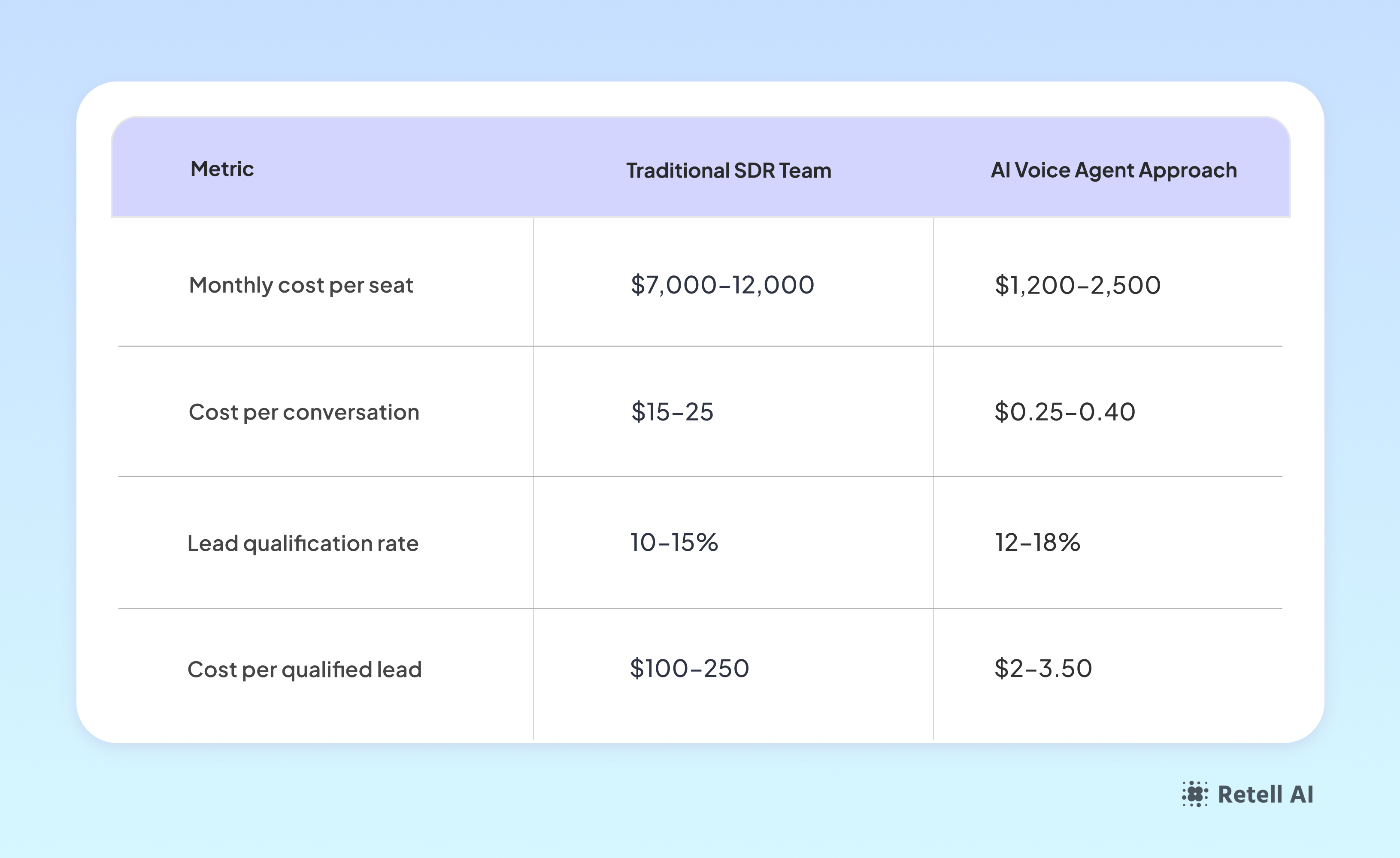
These metrics establish voice AI as a credible operational investment, not a speculative experiment. The combination of scalable automation, intelligent call handling, and customer experience gains is reshaping how enterprises define ROI in the contact center.
Curious what kind of return AI call automation could deliver to your sales team? Use our ROI calculator to model to effortlessly assess potential savings and ROI of automating call operations with Retell!
See how much your business could save by switching to AI-powered voice agents.
Total Human Agent Cost
AI Agent Cost
Estimated Savings
AI call technology has matured dramatically, rendering many common objections obsolete. By understanding the current capabilities of AI voice agents, enterprises can move forward with confidence and realize substantial benefits:
Forward-thinking organizations recognize that hesitation based on outdated assumptions creates a competitive disadvantage as peers capture these benefits.
Wondering how modern AI voice agents compare to your expectations? Experience the latest conversational capabilities firsthand and evaluate potential impact for your specific use cases.
Book a personalized AI call assessment →
A Demo Phone Number From Retell Clinic Office