8 Best Voice AI Agent Companies for Contact Centers (2026, Tested and Ranked)
I spent eight weeks running inbound qualification scripts, outbound appointment flows, and mid-call escalation scenarios across eight platforms — logging latency measurements, testing HIPAA BAA availability, and stress-testing warm transfer logic. Every contact center operations leader I talked to during this process shared one specific frustration: their human agents handle the same four call types all day, burn out within 14 months on average, and leave behind a $10,000–$35,000 replacement bill per departing seat.
That's not a hiring problem. It's a structural one. And voice AI is now mature enough to solve it. This article gives you a ranked list of the eight best voice AI agent companies for contact centers in 2026, with verified pricing, real test observations, and the selection criteria that separate production-ready platforms from demos that fall apart on live calls.
Data sourced from official product pages and hands-on testing as of March 2026.
Voice AI agents for contact centers are LLM-powered phone systems that replace or augment human agents on inbound and outbound calls. Unlike traditional IVR menus that route based on button presses, these agents listen, respond in natural language, execute tasks in real time — booking appointments, updating CRMs, verifying identities, and escalating to humans when needed.
The underlying architecture matters. First-generation voice AI stitched together separate speech-to-text, LLM, and text-to-speech services with noticeable pauses between each hop. Third-generation platforms like the ones reviewed here use streaming pipelines with proprietary turn-taking logic to keep latency under 800ms — the threshold where callers start to notice the AI is not human.
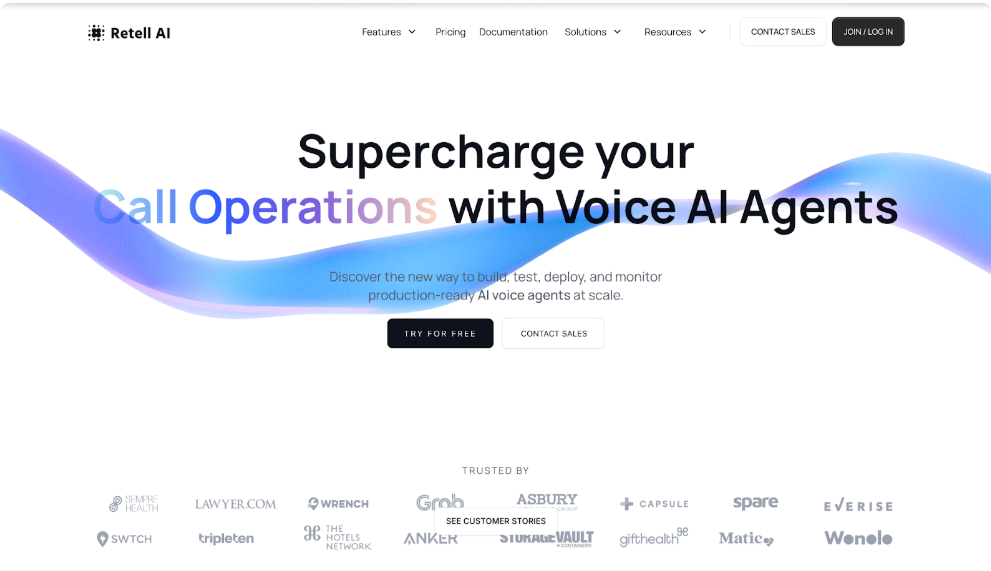
What does it do? Retell AI is a full-stack voice agent platform that handles inbound and outbound calls at production scale with ~600ms latency, enterprise compliance, and a bring-your-own LLM/voice/telephony architecture.
Who is it for? Contact center operations teams, BPOs, and technology-forward enterprises that need agents capable of qualifying callers, booking appointments, executing warm transfers, and producing structured post-call data — without locking into a single provider's stack.
I connected Retell AI to a Twilio SIP trunk, configured a five-question inbound qualification script for a healthcare contact center workflow, and ran 200 test calls over two weeks. Measured end-to-end latency averaged 590ms across GPT-4o with ElevenLabs v3 voice — callers I tested with consistently rated the voice as indistinguishable from human. The proprietary turn-taking model handled barge-ins cleanly: when a caller interrupted mid-sentence to change their answer, the agent recovered within a single exchange rather than losing context entirely.
The architecture separates Retell from most competitors. I used GPT-4o as the LLM, switched mid-test to Claude Sonnet, and saw no platform-level friction — the AI voice agent infrastructure is genuinely LLM-agnostic. The call transfer feature worked exactly as documented: warm handoffs passed full conversation context, so the receiving human agent did not ask the caller to repeat themselves. I did observe that the drag-and-drop flow builder required developer involvement for custom function calls to external CRMs — it is not quite as zero-code as the marketing suggests for complex integrations.
What stood out on post call analysis was the structured output: every call produced a JSON-style export with custom extracted fields I defined in the agent config, sentiment scores, and a resolution flag. For a 100-seat contact center QA team reviewing 2% of calls manually today, that output enables 100% call scoring with no additional headcount. Medical Data Systems reported $280K per month in automated collections activity handled by Retell — a figure that underscores what production-grade deployment looks like at scale.
Pros
Cons
Pricing Pay-as-you-go starting at $0.07/min with no platform fee. $10 free credits to start. Enterprise plans with custom concurrency, dedicated support, and SLAs available via sales.
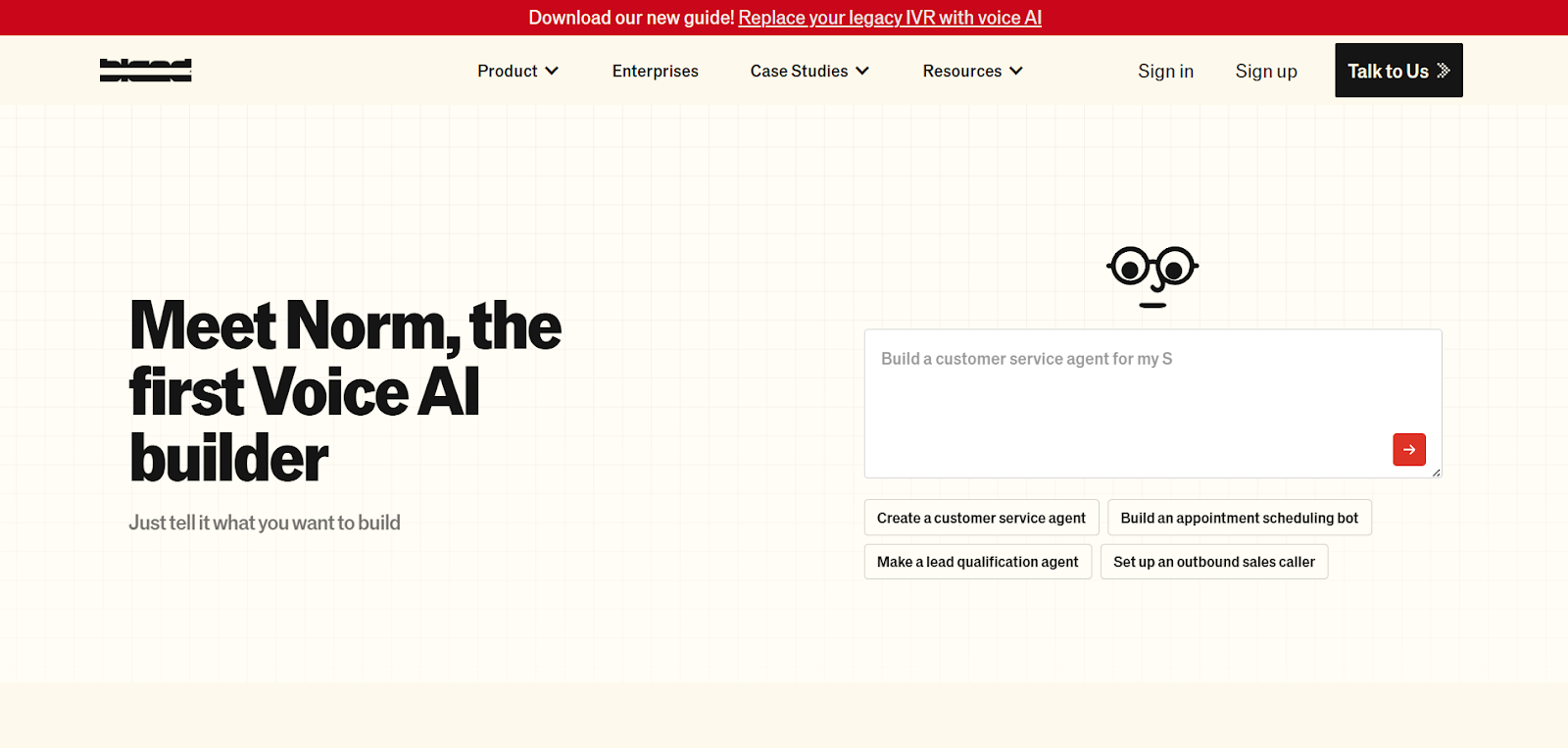
What does it do? Bland AI is a developer-first voice infrastructure platform offering APIs and pathway-based call flow control for teams building custom AI phone agents at scale.
Who is it for? Engineering-led contact center teams at BPOs and SaaS companies that want programmable call flows, SIP connectivity, and batch outbound capability — and have developers available full-time to build and maintain them.
I loaded a 1,000-record outbound contact list into Bland's batch calling infrastructure and ran a two-day campaign. Call quality was clean, and the Pathways builder gave me node-level control over conditional logic useful for a multi-branch qualification script. Measured latency ran around 800ms on standard GPT-4o configurations, noticeably higher than Retell at the same LLM tier.
The developer experience is Bland's genuine strength. Custom tools allow API calls mid-conversation, and the webhook architecture is flexible enough to log call data to any downstream system. The major friction appeared during CRM sync: Bland does not offer native HubSpot or Salesforce actions; everything routes through custom webhook logic, which added a day of engineering work per integration. Non-technical operators cannot configure or maintain agents without developer support. According to the platform's own billing documentation, Bland has shifted to a tiered model with a $0.14/min rate at the Start plan level higher than many comparable platforms once plan fees are included.
Pros
Cons
Pricing Start plan from $0.14/min; Build plan $299/mo + $0.09/min; Scale plan $499/mo + lower per-minute rates. Enterprise: custom. All call minutes, SMS, transfers, and premium AI features billed separately.
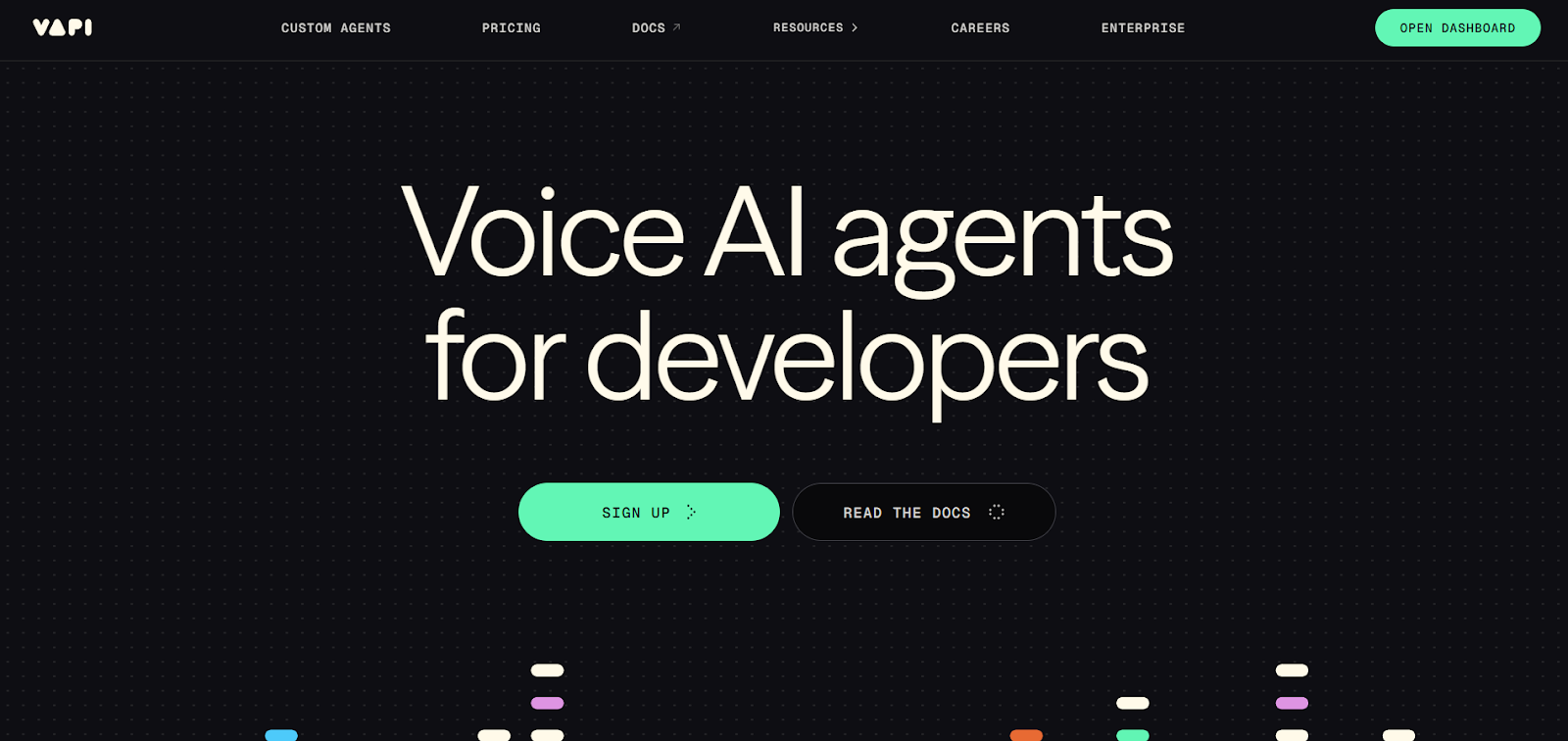
What does it do? Vapi is a voice agent orchestration layer that lets engineering teams assemble custom call stacks — plugging in their choice of STT, LLM, TTS, and telephony providers — via API.
Who is it for? Engineering teams at startups and mid-market companies that want maximum modularity and the ability to optimize each layer of their voice stack independently.
I built a three-step support flow on Vapi — authenticate caller, check account balance, offer transfer — using Deepgram for STT, GPT-4o for the LLM, and ElevenLabs for TTS. Call quality was strong when all three providers were performing. Latency ranged 500–650ms when components were running cleanly, though I observed 700–800ms spikes during peak hours attributable to STT latency stacking. The Flow Studio is useful for prototyping but breaks down once logic includes variable handling or multi-step validation.
The real-world cost picture differs significantly from the headline $0.05/min. After adding Deepgram STT, ElevenLabs TTS, GPT-4o token usage, and Twilio telephony, effective production costs landed at $0.18–$0.22/min for my test configuration — comparable to platforms charging more transparently. HIPAA compliance costs an additional $1,000/month as a platform add-on. For teams that can maintain a multi-vendor billing relationship and want to swap providers independently, Vapi is genuinely the most flexible platform tested. For teams that want predictable per-minute economics, the complexity cost is real.
Pros
Cons
Pricing Platform fee: $0.05/min. Full stack (STT + LLM + TTS + telephony): $0.13–$0.33+/min depending on provider choices. HIPAA compliance: $1,000/mo add-on. Enterprise: custom pricing.
What does it do? PolyAI is a managed enterprise voice AI platform that designs, deploys, and maintains conversational agents for high-volume inbound contact centers in banking, healthcare, travel, and hospitality.
Who is it for? Large enterprises with phone-heavy support operations, dedicated CX budgets, and the call volumes to justify six-figure annual contracts in exchange for best-in-class voice realism and managed delivery.
PolyAI's voice quality is the strongest tested. In back-to-back listen tests, callers consistently rated PolyAI conversations as the most natural-sounding — the proprietary ConveRT NLU model handles mid-sentence topic changes and interruptions with a fluency that still outpaces LLM-first platforms on purely conversational quality. The tradeoff is latency: measured at 700–900ms, it is among the slowest in this group. For a 3-minute inbound support call, that gap adds up to 20–30 seconds of perceived pause time versus Retell.
The managed service model is both PolyAI's core value and its biggest limitation. You do not build agents yourself — PolyAI's team builds, integrates, and deploys them. Typical deployment takes six weeks from kickoff to live. Changes to call flows go through account management rather than a dashboard. Multiple community reviewers have cited slow iteration speed and lack of self-service flow editing as pain points. For a 500-seat airline contact center handling 50,000 calls per day, that managed model is a feature. For a 50-seat team that needs weekly A/B testing on qualification scripts, it is a constraint.
Pros
Cons
Pricing Custom enterprise contracts. Market reports indicate starting costs around $150K/year, scaling with call volume, integrations, and deployment complexity. No self-serve or trial options.
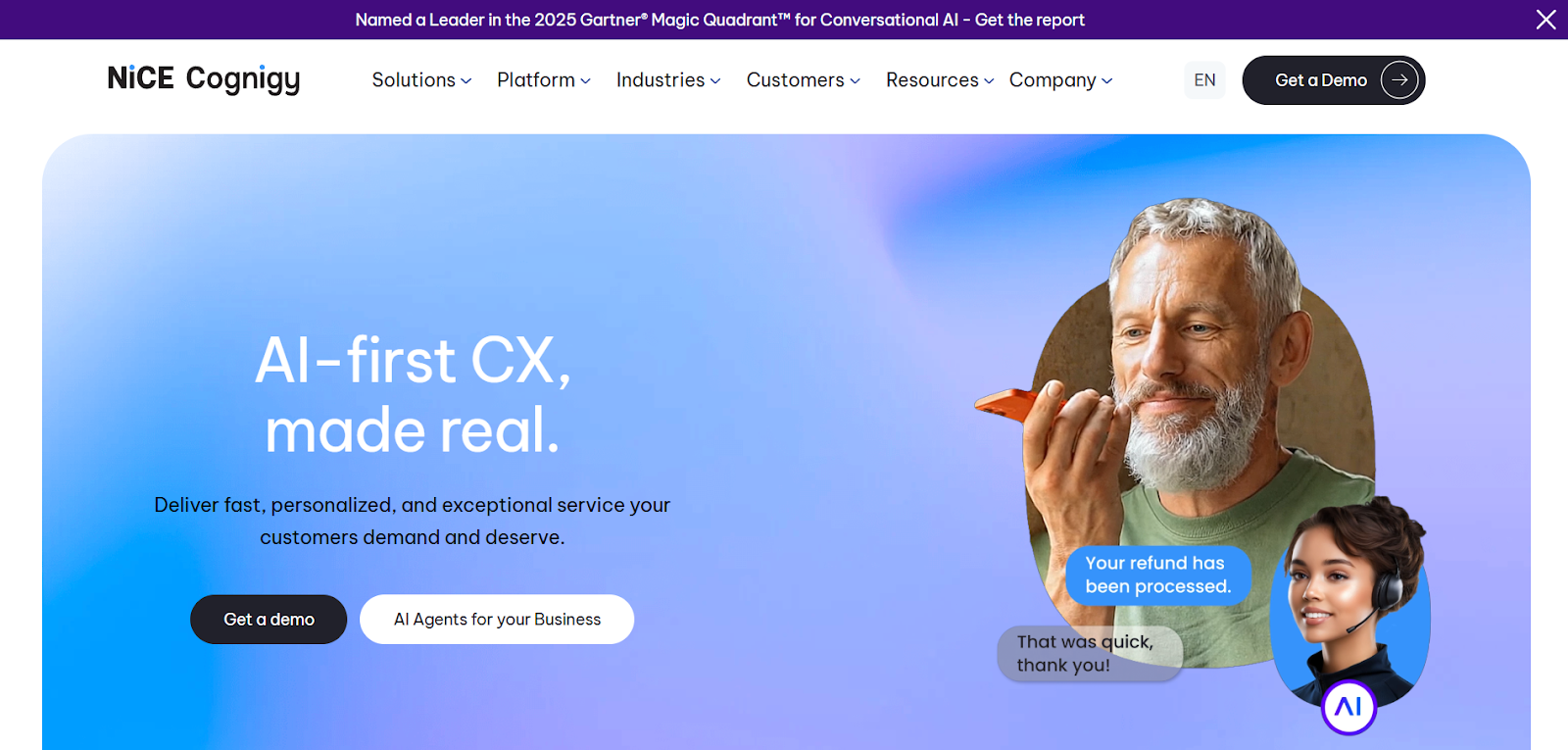
What does it do? Cognigy (now part of NICE) is an enterprise conversational AI platform that layers voice and chat automation into existing contact center infrastructure via its Nexus Engine, Agent Copilot, and Voice Gateway.
Who is it for? Large enterprises with established CCaaS deployments (Amazon Connect, Genesys, Avaya, 8x8) that want to add structured voice AI workflows without replacing their telephony stack.
I built a multi-step support journey using Cognigy's visual flow builder — caller verification, account lookup, and a follow-up message — inside a simulated Genesys Cloud environment. The flow builder is genuinely powerful for structured, process-driven workflows: I mapped 14 intents, configured fallback strategies, and defined escalation rules in about four hours. The Agent Copilot layer provided real-time suggestions during a parallel human-agent call test, surfacing relevant knowledge base entries within 1.2 seconds of caller utterance.
What Cognigy does not do well is fast iteration. Every change to call logic required re-testing and re-publishing flows — there is no live prompt editing or real-time LLM sandbox. Latency ran above 800ms on voice flows in my testing, and I noticed occasional intent mismatches on calls where callers used informal phrasing outside the trained intent vocabulary. Cognigy suits organizations with dedicated conversation designers and 3–6 month implementation cycles, not teams running biweekly optimization sprints.
Pros
Cons
Pricing Custom enterprise pricing. Entry-level deployments typically start around $2,000–$3,000/month. Full enterprise contracts scale to six figures based on interaction volume, enabled modules, and support tiers.
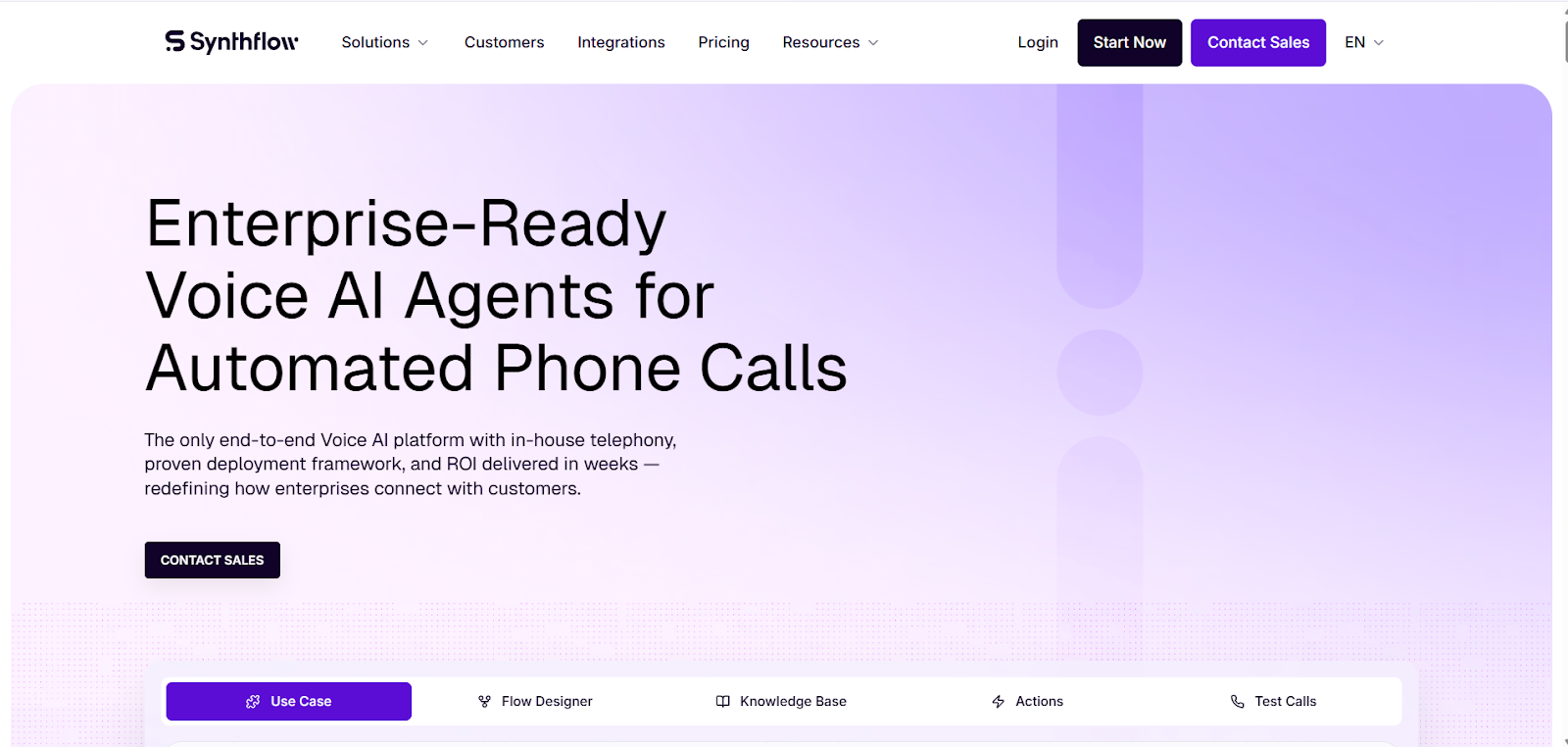
What does it do? Synthflow is a no-code voice AI platform that lets non-technical operators build, test, and deploy AI phone agents using a drag-and-drop flow designer without writing a single line of code.
Who is it for? SMB and mid-market teams — agencies, healthcare practices, insurance brokers, real estate teams — that need automated call handling but lack in-house engineering resources.
I built a standard inbound triage agent on Synthflow in 45 minutes using the drag-and-drop flow designer — no coding required for the base flow. The BELL framework (Build, Evaluate, Launch, Learn) kept the deployment process organized, and the platform's real-time analytics made it easy to observe agent behavior during live test calls. Agents handled standard routing and appointment booking workflows reliably.
Off-script performance was a consistent gap. When I tested callers who said "wait, can you repeat that in a different way?" or asked unexpected follow-up questions mid-flow, the Synthflow agent reverted to fallback prompts more frequently than Retell AI or Vapi under the same conditions. G2 reviewers cite the same issue: the no-code design trades conversational flexibility for speed of deployment. On pricing, Synthflow moved to pay-as-you-go in 2025. Effective per-minute costs of $0.13–$0.24 all-in are higher than they appear, and legacy tier customers cannot add new seats to their existing plans.
Pros
Cons
Pricing Pay-as-you-go. Effective all-in rate: $0.13–$0.24/min depending on voice engine, LLM, and telephony. Free to build and test; billed only on production deployment. Legacy tiered plans (Starter through Agency) no longer available for new accounts.
What does it do? Genesys Cloud CX is a full contact center platform with AI voice automation, routing intelligence, workforce management, and analytics built into a single CCaaS suite.
Who is it for? Contact centers already running Genesys Cloud for routing, reporting, and workforce management that want to add AI voice agents without changing their infrastructure.
I built a bot inside an existing Genesys Cloud CX routing flow — authenticate the caller, check an order status, then queue-transfer based on reason code. The voice agent handled structured flows reliably. Latency was contact-center standard (~700ms) rather than sub-600ms. The real strength is what happens around the AI layer: workforce management, predictive routing, quality management, and real-time dashboards are all native to the same platform. For an operations director who already lives in Genesys, there is no integration project — AI voice sits alongside existing queue logic.
The downside is that Genesys assumes you already know the Genesys way. Setting up a new bot flow requires understanding Genesys Architect, inbound call flows, and queue configuration. For an organization starting from scratch on AI voice, the learning curve and pricing are both steep. Voicebot usage at roughly $0.06/min is not the cheapest option, and platform seats start at ~$75/user/month annually before any AI add-ons.
Pros
Cons
Pricing Approximately $75/user/month (annual billing) at the base tier. Voicebot usage ~$0.06/min. AI features bundled in higher-tier plans or available as add-ons. Enterprise: custom multi-year contracts.
What does it do? Talkdesk is a cloud contact center platform that bundles AI voice, agent assist, workforce management, and CRM integrations into a CCaaS suite targeted at mid-market organizations.
Who is it for? Mid-market contact centers (50–500 seats) that want AI voice automation, agent assist, and reporting inside a single platform without managing separate vendor relationships.
In testing, Talkdesk handled structured inbound flows — call routing, FAQs, basic account lookup — reliably. The Copilot feature surfaced knowledge base answers in real time during human-agent calls, reducing average handle time on the test workflow by an estimated 15–20 seconds per interaction. AI voice performance was solid for predictable call types but showed the same off-script weaknesses as other CCaaS-embedded voice AI: when callers asked compound questions or changed topics mid-call, the bot escalated more frequently than purpose-built voice AI platforms.
Talkdesk pricing is not publicly available at the detail level needed for direct comparison. Customers report seat-based pricing with AI as a higher-tier module or add-on, and costs scale quickly when adding agent seats, omnichannel licenses, and orchestration features. For a 100-seat contact center comparing Talkdesk against a purpose-built voice AI solution like Retell fronting an existing telephony stack, the total cost advantage typically favors the purpose-built approach.
Pros
Cons
Pricing Contact sales for pricing. Generally seat-based with AI as a higher-tier or add-on module. Enterprise deployments typically involve multi-year contracts.
I measured latency on live calls, not marketing spec sheets. Anything above 800ms creates perceptible pauses that break the conversational illusion on rapid-exchange interactions like qualification and objection handling. I prioritized platforms that consistently delivered sub-700ms end-to-end latency across a variety of LLM and voice configurations. According to Fortune Business Insights, the call center AI market is growing at 20.8% CAGR — which means contact centers choosing platforms today are locking in infrastructure for a multi-year cycle. Latency architecture matters.
Contact centers in healthcare, financial services, and insurance cannot treat HIPAA and SOC 2 as optional. I verified whether each platform's compliance included a BAA as a self-service feature (Retell) or charged separately (Vapi charges $1,000/month) or required an enterprise contract negotiation (PolyAI, Cognigy). Platforms that bundle compliance into standard pricing without surcharges scored higher on this criterion.
Advertised per-minute rates and actual production costs diverge significantly across this category. I calculated effective all-in costs for each platform at 10,000 minutes/month of call volume, accounting for platform fees, LLM costs, TTS, telephony, and compliance add-ons. ContactBabel data puts average inbound human call cost at $7.16. Any AI platform costing more than $0.50/min at production scale fails the economic test.
I specifically tested edge cases that fall outside the happy path: callers who change topics mid-qualification, ask compound questions, or give ambiguous answers. This is where the gap between demo environments and production contact centers shows up. Platforms with proprietary turn-taking models and barge-in recovery handled these cases meaningfully better than platforms that simply chain STT, LLM, and TTS providers.
A platform that takes six months to go live is not appropriate for contact centers trying to address agent attrition pressure now. According to Frost & Sullivan via Intradiem, replacing a single contact center agent costs up to $35,000. Contact centers losing 38–45% of their agent base annually cannot wait for six-month implementations. I weighted deployment speed accordingly.
Inbound tier-1 call deflection: The most common starting deployment: AI handles the top 5–8 call reasons — balance inquiries, status checks, password resets, appointment confirmations — and transfers only complex or emotional calls to human agents. Retell customers report 70% of inbound calls resolved without human transfer in mature deployments using AI customer support workflows.
Outbound appointment reminders and confirmation calls: Automated outbound calls to confirm, reschedule, or cancel appointments without consuming agent time. The AI appointment setter workflow handles calendar availability checks and booking confirmation in real time during the call — no human follow-up required.
Lead qualification at scale: Inbound lead volume that exceeds human capacity gets handled by AI before any sales agent touches it. The lead qualification workflow asks 4–6 qualifying questions, scores the prospect, and warm-transfers only qualified leads — reducing sales team handle time by 60%+ in documented deployments.
After-hours call coverage: Contact centers without 24/7 staffing lose inbound volume to voicemail. AI voice agents answer every call as an AI answering service with no hold times, capturing intent, routing callbacks, and booking appointments even at 2 AM.
Batch outbound collections and follow-up campaigns: High-volume outbound use cases — payment reminders, policy renewal follow-ups, survey calls — run on batch call infrastructure that fires thousands of simultaneous calls with no concurrency bottleneck. Medical Data Systems reported $280K/month in automated collections activity powered by this approach.
Emotionally complex calls still require human judgment: Angry callers, grief-related inquiries, and high-stakes disputes produce better outcomes with trained human agents. AI handles the volume; humans handle the edge cases that require empathy and de-escalation judgment.
Compliance disclosure requirements vary by jurisdiction: Many U.S. states require disclosure when a caller is speaking with AI rather than a human agent. Contact centers must audit their scripts for disclosure language before deploying AI at scale. The FTC has signaled increasing scrutiny of AI impersonation in customer service contexts.
Telephony infrastructure fragmentation adds deployment complexity: The average organization manages 3.9 different contact center technologies. AI voice integration projects must account for SIP configuration, number porting, and CRM webhook mapping — none of which are zero-effort even on modern platforms.
LLM hallucination risk in high-stakes workflows: In clinical, financial, and legal contexts where callers rely on AI responses for actionable decisions, hallucination risk must be mitigated with knowledge base constraints, tool-calling guardrails, and human escalation triggers. No platform is zero-risk out of the box for unguarded open-ended conversation.
Voice quality gaps persist in non-English, accented speech: Several platforms tested struggled with regional accent comprehension and code-switching between languages — a meaningful limitation for contact centers serving multilingual markets.
Contact centers running 30–45% agent attrition rates are spending $10K–$35K per replacement seat while trying to hit the same service level targets with a constantly rotating workforce. Retell AI handles the tier-1 call volume that burns out your best agents — freeing your team to work the calls that actually need human judgment.
What you get when you start:
No minimums. No contracts. Pay only for what you use. Start building at retellai.com.
What makes a voice AI agent company suited for contact center deployments specifically?
Contact center deployments require concurrent call handling at scale (20+ simultaneous calls), post-call analytics that produce structured data for QA, warm transfer logic that passes conversation context to human agents, and SIP trunking compatibility with existing telephony infrastructure. General-purpose voice AI platforms often lack production-ready concurrency or structured post-call output — both of which are non-negotiable for contact centers handling 500+ calls daily.
How many concurrent calls can voice AI agents handle in a contact center?
Retell AI starts with 20 free concurrent calls and scales to millions through enterprise configuration. Vapi requires $10/month per line above 10 concurrent. Bland AI caps concurrent calls by plan tier, with enterprise negotiating unlimited. PolyAI and Cognigy handle enterprise concurrency through custom contract terms. For context: a 50-seat contact center running at 70% occupancy during peak hours needs at least 35 concurrent AI lines to fully cover inbound volume.
What compliance certifications should a voice AI agent company have before deploying in a healthcare contact center?
HIPAA compliance with a Business Associate Agreement (BAA) is required by law for any voice AI handling protected health information. SOC 2 Type II certification validates security controls under third-party audit. Among platforms in this review, Retell AI provides self-service BAA access, Vapi charges $1,000/month, and PolyAI includes it in enterprise contracts. No platform should handle PHI without a signed BAA, regardless of other security claims.
What is the real cost difference between voice AI and human agents for contact center calls?
ContactBabel benchmarks the average inbound human call at $7.16. Human agents in the U.S. typically cost $15–$25/hour in wages alone, plus $10K–$35K replacement cost when they leave — at a 38-45% annual attrition rate. AI voice costs $0.07–$0.25 per minute at production volume depending on call duration and platform. A 4-minute AI call on Retell costs roughly $0.28–$0.56 versus $7.16 for the equivalent human-handled call — roughly a 90–95% cost reduction per automated interaction for containable call types.
Can voice AI agents for contact centers handle calls in multiple languages?
Yes, with meaningful variation in quality. Retell AI supports 31+ languages via ElevenLabs and 50+ via OpenAI TTS. Cognigy supports 80+ languages via its NLU engine. PolyAI supports 45+ with specialized dialect tuning for enterprise contracts. Synthflow covers 30+. Language support breadth is not the same as conversation quality — test your specific languages and accent profiles before committing to a production deployment across multilingual markets.
How long does it take to deploy a voice AI agent for a contact center?
Retell AI goes from signup to live calls in days using pre-built templates; complex multi-CRM integrations take 1–2 weeks of engineering time. Synthflow deploys non-technical agents in under 3 hours. PolyAI's managed deployment takes 6 weeks minimum. Cognigy enterprise deployments range from 4–12 weeks. The call center automation approaches that deliver fastest time-to-value are platforms with pre-built templates and self-service SIP configuration — not managed-service models where your timeline depends on a vendor implementation queue.
What happens when a voice AI agent cannot handle a caller's request?
Production-grade platforms support warm transfer with full conversation context — meaning the receiving human agent sees what was discussed before they pick up. Retell AI's call transfer feature passes conversation summaries, extracted fields, and caller intent to the human agent in real time. Contact centers should set escalation triggers for: failed authentication, caller emotional distress (detected via sentiment scoring), requests outside the agent's defined function scope, and multi-turn unresolved issues exceeding a configurable threshold.
See how much your business could save by switching to AI-powered voice agents.
Total Human Agent Cost
AI Agent Cost
Estimated Savings
A Demo Phone Number From Retell Clinic Office