Replicant Alternatives Compared: Best Voice AI Platforms
17
MIN READ
September 17, 2026
Replicant helped put autonomous voice on the enterprise map. Its “Thinking Machine” markets near-human calls, multi-intent handling, and sub-second responses, which is why you’ll see it in serious contact-center conversations across regulated industries.
But the market has moved fast: newer voice-first stacks are built specifically for businesses aiming to optimize cost, speed, or integration flexibility. Modular pricing and hybrid no-code + API workflows now make it easier to pilot in days, forecast costs, and keep tight control over latency and integrations.
In this article, we’ll walk you through the best Replicant alternatives, and the trade-offs to watch as you evaluate what’s right for your team.
Replicant is an enterprise conversational AI platform designed to automate customer service over voice and digital channels. Its flagship “Thinking Machine” aims to resolve Tier-1 requests end-to-end, handling multiple intents and responding quickly to keep calls flowing naturally.
Replicant states sub-second responses, a 96% inference accuracy rate and 30 plus languages for the Thinking Machine, and says the platform has handled more than a billion automated minutes in production since 2020, across customers it names including AAA, ADP, DoorDash, Fanatics and Sunrun (source).
The platform wraps automation with conversation intelligence (QA/insights) and an implementation model geared to larger contact centers. Replicant's AI offers advanced automation and conversation intelligence tailored to enterprise business logic, ensuring that AI-generated responses align with organizational workflows and policies.
In Replicant’s own framing, the system can answer in under a second and is delivered as a full-service partnership that includes delivery support and model updates.
Here’s a breakdown of Replicant’s main limitations, key areas where it may fall short for B2B buyers evaluating voice AI at scale:
This post’s main criticism of Replicant is that you are buying a managed relationship rather than a platform. That argument only works if it is applied consistently, so here it is in full.
A vendor-built agent gets you to production with less guesswork, and for some teams that is the right trade. The cost shows up later. When the business changes, the people closest to your customers describe the change rather than making it, and your timeline runs at the vendor’s pace. Ask the question directly during evaluation: in month six, who makes the change and how long does it take?
Retell hands you the builder. Your team builds, tests and adjusts the agent directly, so a change does not become a ticket, a queue, or another SOW. You still get hands-on help standing the first agent up.
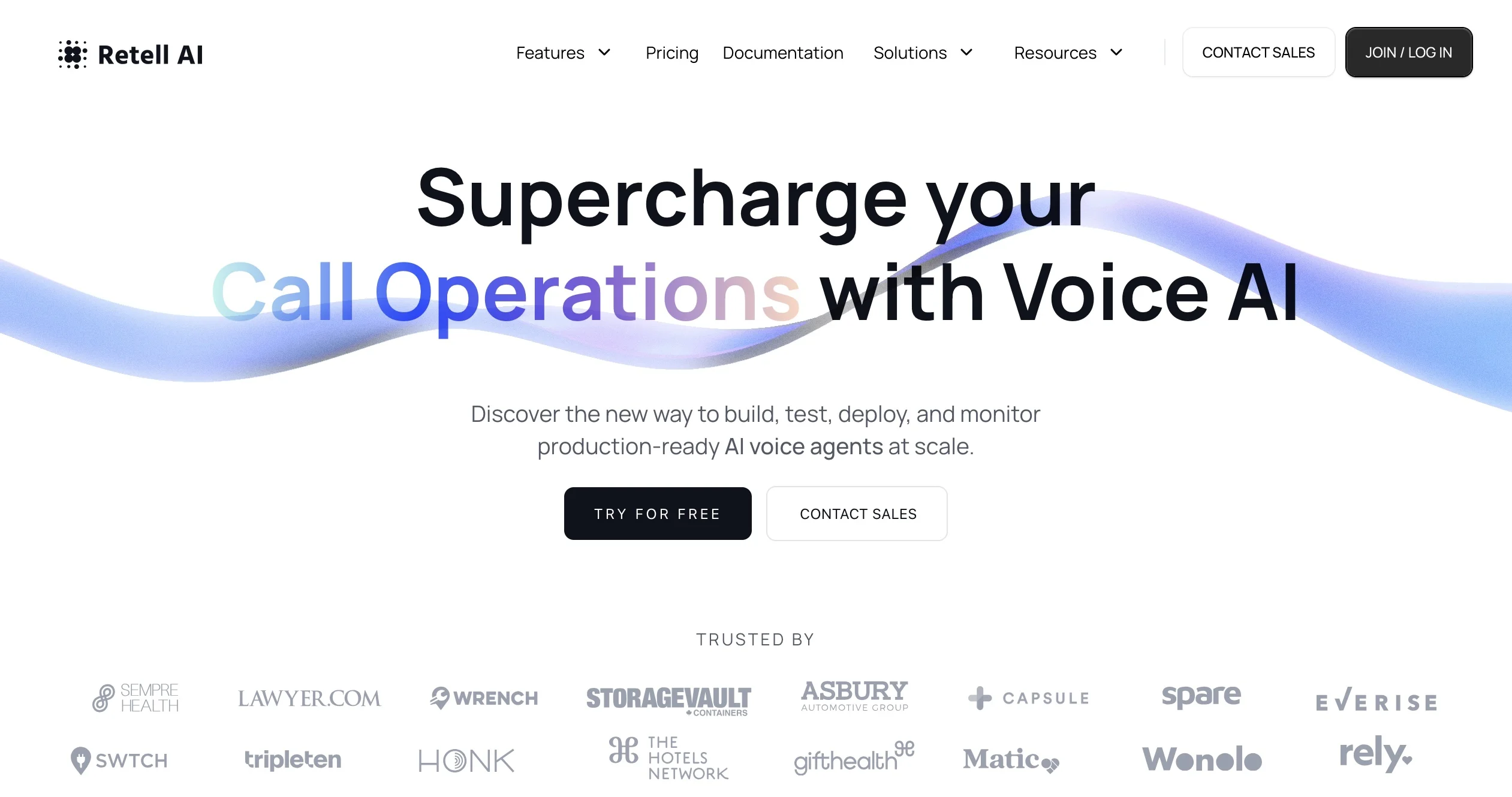
Retell AI is one of the top alternatives to Replicant, and is considered among the leading platforms for building AI voice agents. Exploring these options can help you find the best fit for your needs, whether you prioritize advanced features, performance, or the cheapest solution for specific use cases.
Replicant offers strong automation, but Retell stands out for its real-time voice performance and flexible setup. With sub-second latency, transparent pay-as-you-go pricing, and native CRM integrations, Retell makes it easy to launch and scale voice agents including as an AI answering service that resolves routine inquiries without manual support, and without heavy infrastructure or long onboarding cycles.
It offers a developer-friendly platform with a drag-and-drop interface for quickly building, deploying, and monitoring AI voice agents. It supports advanced LLMs, multilingual voice models, real-time workflows, and integrations with telephony providers like Twilio.
These features can help expand your reach by supporting multiple languages and broader user engagement.
For a clear overview, see the table below summarizing key features and use cases of each alternative, including cost-effective options and their benefits. Retell also includes pre-built templates for common use cases like lead qualification, AI appointment setter flows, and customer support.
Retell AI excels in areas like low-code infrastructure, rapid deployment, and easy integration, making it stand out for teams looking to quickly implement voice AI solutions.
In competitive evaluations, the difference buyers notice is how the agent handles an interruption and how cleanly it hands a caller to a person. Run a side-by-side with identical prompts on your own call types, interrupt the agent mid-sentence, and listen to what happens next. That is the comparison a spec sheet cannot give you.
Retell publishes a full rate card. Voice infrastructure, the voice you choose, the model you choose and telephony are each priced separately, so you can cost a deployment before you build it rather than after a sales call. Enterprise is custom quoted.
You are charged only for connected call minutes, with no billing for idle time. The base price covers Retell’s core voice AI services, while additional costs account for telephony and advanced large language models.
This structure ensures predictable spending with no hidden fees, allowing businesses to scale seamlessly with their support center activity and call volume. A free $10 credit and limited concurrent calls are included for testing.
Phone numbers cost $2 a month and verified numbers $10 a month. The first 20 concurrent calls and the first 10 knowledge bases are free.
G2 Rating: 4.8/5 (612 reviews)
Review: “Retell AI has completely transformed the way we manage automated calls, with impressive voice quality and understanding”.
Product teams and enterprises, as well as businesses aiming to automate customer interactions and scale efficiently, seeking a scalable, flexible voice AI platform that can be tailored to specific business needs, with transparent pricing, especially those focused on call center and outbound sales automation.
Build your first Retell agent in minutes for free.
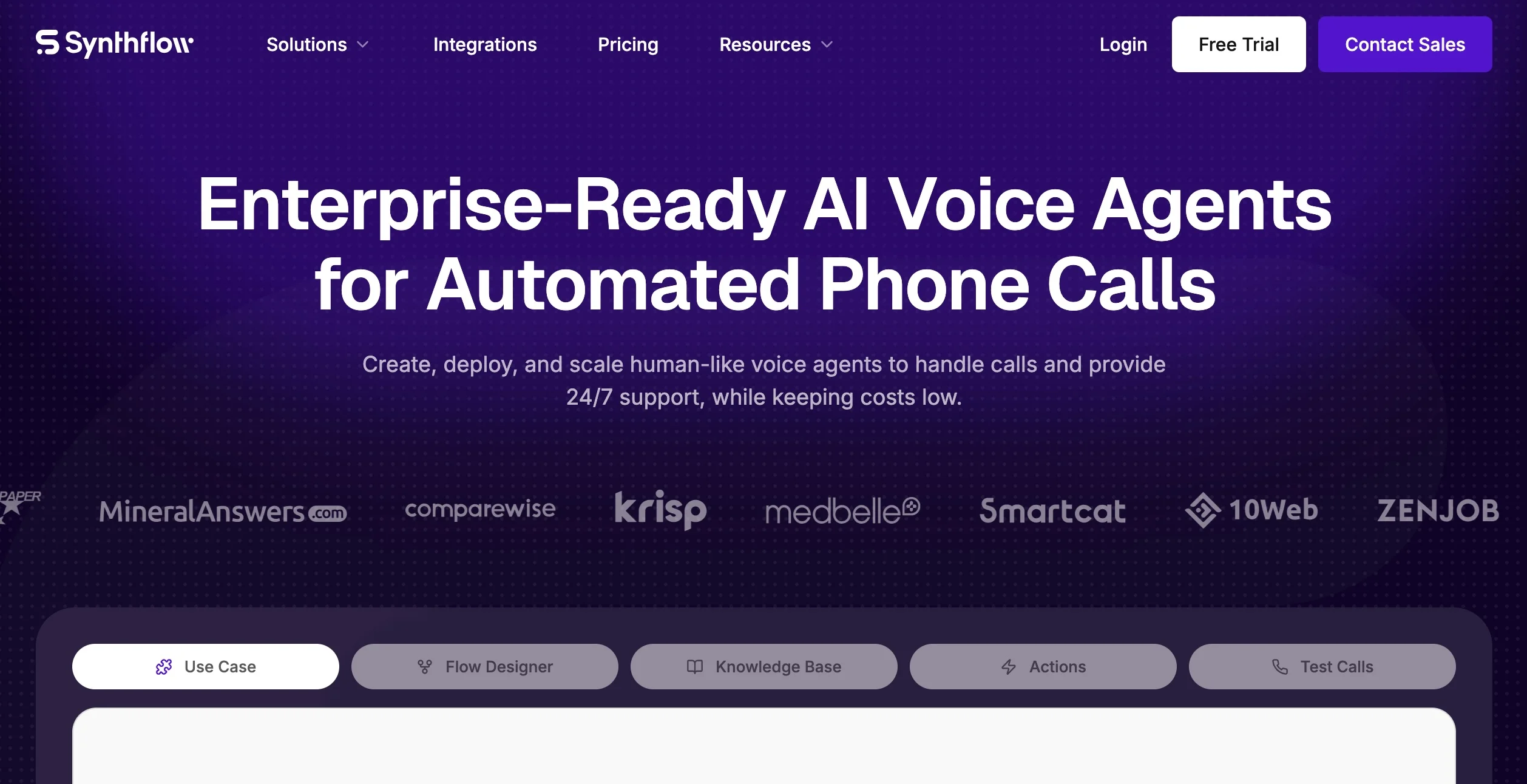
Synthflow is a scalable voice AI with a no-code visual workflow builder, real-time personalization, and deep CRM integrations, perfect for automating workflows like an AI appointment setter or outbound calling assistant.
Supports HIPAA compliance, inbound routing, and multi-tenant management for agencies. Designed for production-grade voice automation.
Synthflow now sells one way. Enterprise contracts start at $30,000 a year, scoped around call volume, concurrency, telephony setup, integrations, security review and launch support. The $29, $99 and $249 self-serve tiers no longer exist, and there is no free plan.
G2 Rating: 4.5/5 (815 reviews)
Review: “What I like best about Synthflow is that it doesn’t bury you in technical complexity. You don’t need to be a coder or spend weeks wiring together APIs just to get a usable AI voice agent”.
Marketing teams and enterprises with specific business needs in compliance and automation, as well as those requiring robust inbound support automation and deep integrations.

PolyAI specializes in multilingual customer support and call deflection. Integrates with major CRMs and contact center systems, and provides advanced voice customization, deep analytics, and rapid deployment.
PolyAI's pricing is based on call volume and does not offer flat rate pricing or public pricing tiers. PolyAI still publishes no rate, and third-party estimates put enterprise contracts near $150,000 a year. It did open its Agentic Dialog Platform to every builder in May 2026, free for the first two months, with a no-code builder, self-serve API keys and a CLI, so the entry barrier is lower than it was.
G2 Rating: 5/5 (11 reviews)
Review: “There are many options for AI currently in the market. PolyAI impressed us by providing a product that could be launched in a short amount of time without risking quality”.
Large enterprises and contact centers needing fully managed, custom voice AI solutions with top-tier language capabilities.
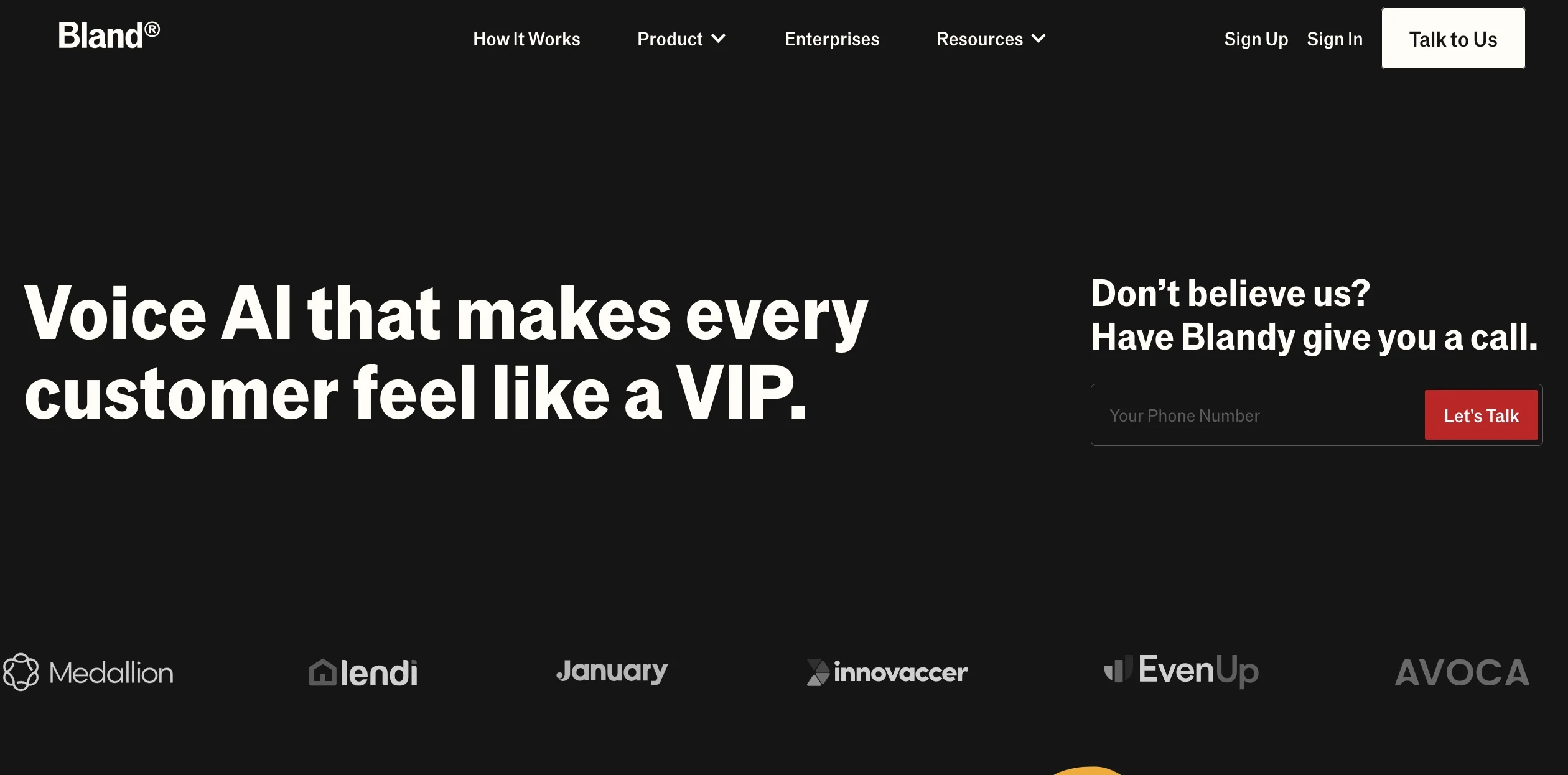
Bland emphasizes hyper-realistic voice experiences with strong security and data governance. It supports high-volume inbound and outbound calling, SMS, and omnichannel workflows, making it ideal for large-scale AI telemarketing operations and enterprise call automation.
Bland markets itself as capable of scaling up to one million concurrent calls, making it attractive to enterprises that demand resiliency.
Bland publishes rates. Start costs $0.14 per minute with no platform fee, 10 concurrent calls and 100 calls a day. Build costs $0.12 per minute plus a $299 monthly platform fee, with 50 concurrent calls. Enterprise is contracted to volume. The per-minute rate covers the language model, speech to text and text to speech, and telephony bills separately.
Large enterprises with strict requirements for privacy, governance, and brand voice customization at scale.
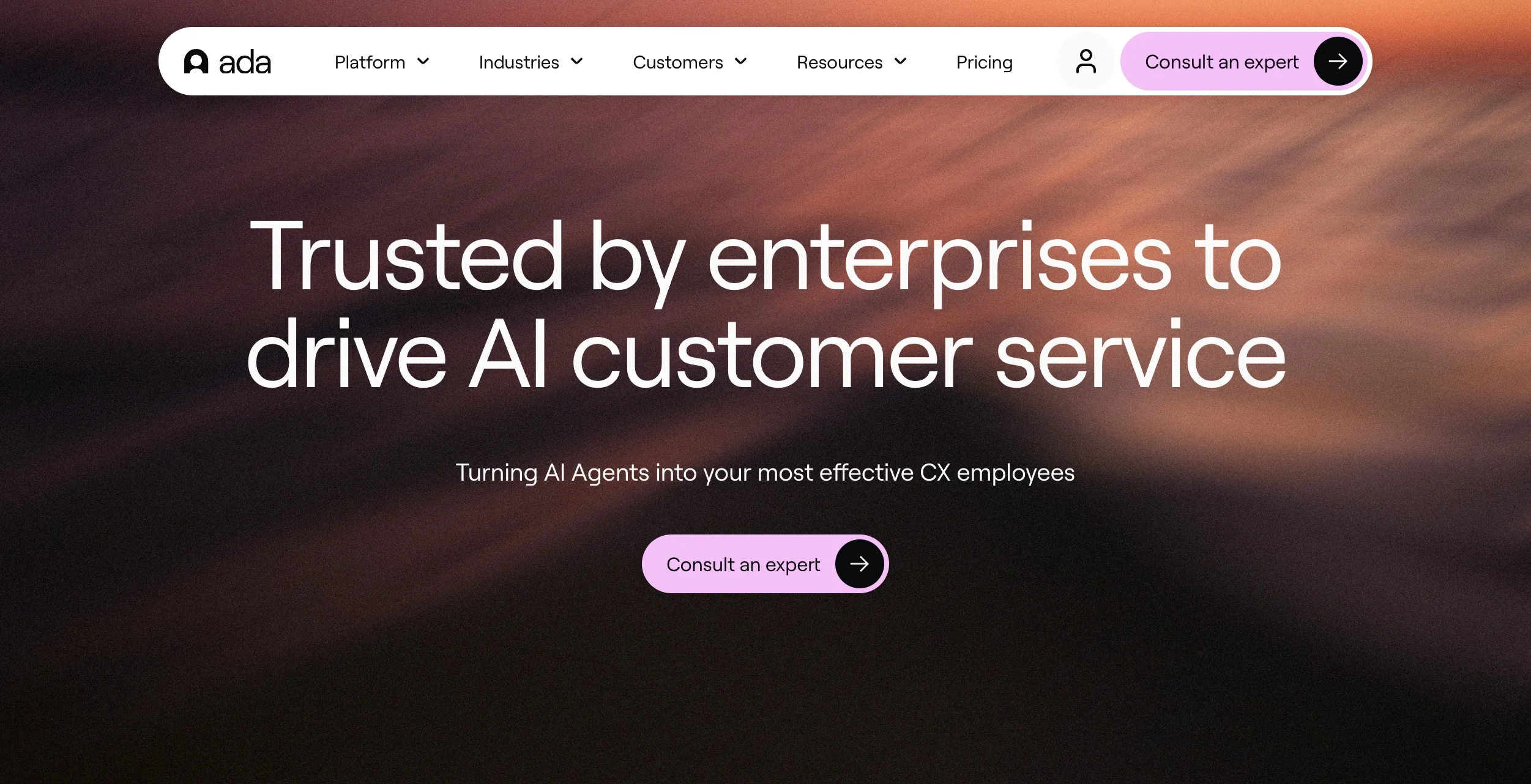
Ada.cx powers AI agents that automate customer service across chat, voice, and email, helping support teams handle complex requests at scale.
Unlike traditional bots that rely on rigid scripts, Ada’s platform was built “AI-first”, meaning its agents can understand intent, trigger workflows, and even escalate to humans when needed, all while maintaining a consistent brand tone.
G2 Rating: 4.6/5 (155 reviews)
Review: “Ada helped our small support team contain the most easy-to-resolve customer inquiries, freeing-up more time for agents to go through our backlog.”
Ada does not offer a free tier or flat rate pricing. Instead, Ada removed its public pricing page during 2026 and now routes every enquiry to a demo request. Third-party contract data puts the entry point near $30,000 a year and the median signed deal near $70,000, with large deployments running past $200,000. Ada started out billing per automated resolution and has moved its default to per-conversation billing, which means you can pay for interactions the agent does not resolve. Ask which meter you are being quoted.
Brands that prioritize customer experience at scale, especially e-commerce, fintech, and telecom companies, where multilingual support and fast automation setup are key.

Sierra AI deploys advanced AI agents for customer service that are uniquely trained to align with a company's specific brand identity.
These agents can reason, predict, and take action not just based on a knowledge base, but also by adhering to the company’s tone, values, and policies for a highly personalized interaction.
G2 Rating: 4.3/5 (12 reviews)
Review: “User friendly, fast and many supported languages. Very complex setup process and more bugs then competitors”.
Sierra publishes no prices. Third-party buyer guides put the platform floor near $150,000 a year, implementation at $50,000 to $200,000 on top, and year-one totals at $200,000 to $350,000. Sierra bills per outcome, at a reported $1.00 to $2.50 per resolved interaction, and says it does not charge for escalations. Sierra has not confirmed those figures.
Unlike some competitors, Sierra does not offer public pricing tiers or flat rate pricing. Instead, final pricing is customized based on agent complexity and expected call volume. This approach ensures that costs are tailored to your support center’s needs and are based on call volume while delivering powerful, brand-aligned automation.
Sierra is ideal for organizations serving diverse customer bases, where a consistent voice and adherence to company policy are critical, especially in telecommunications and financial services managing diverse customer segments.
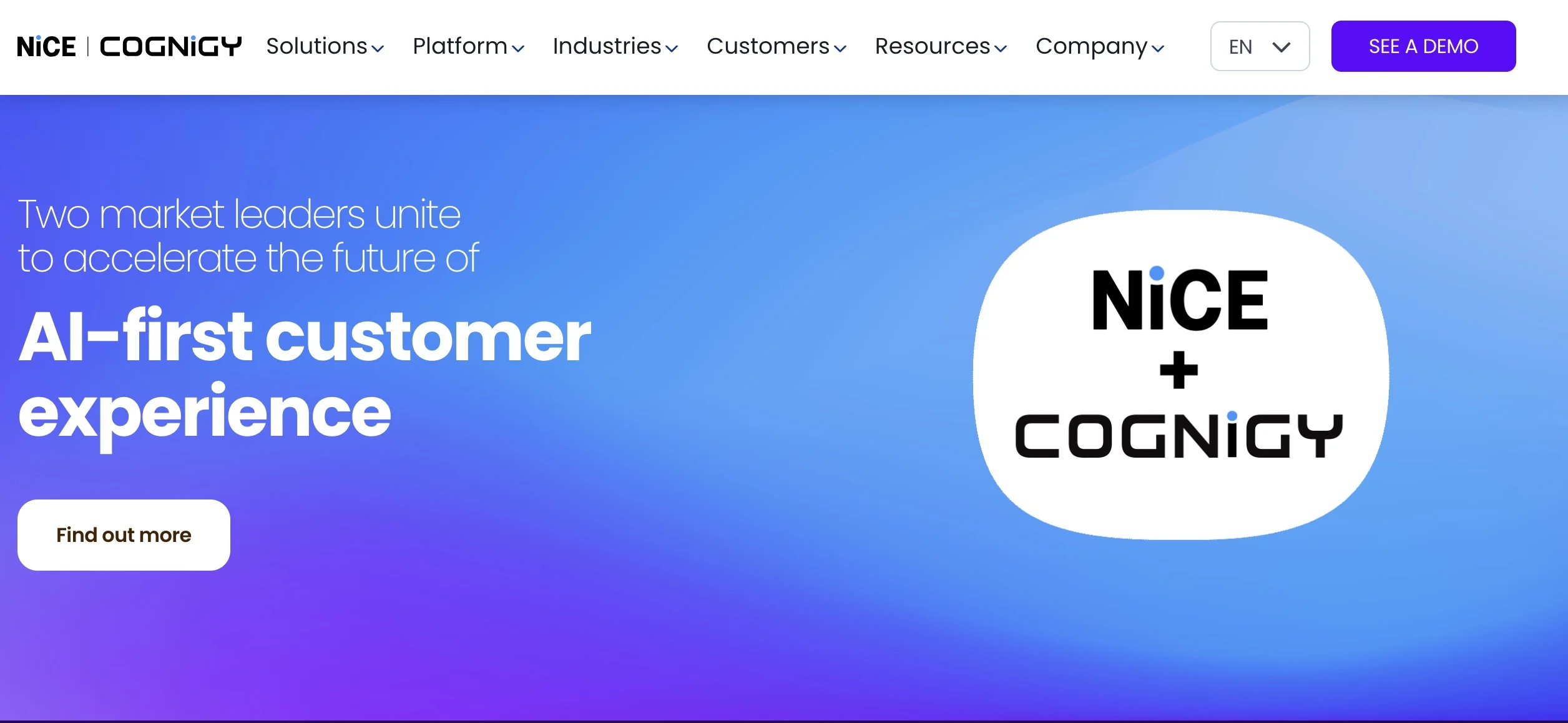
Cognigy is now part of NiCE, which closed its roughly $955 million acquisition in September 2025. The platform still runs voice and chat across complex enterprise deployments, but you are buying from NiCE.
It supports voice and chat channels, advanced orchestration, multilingual interactions, and customizable workflows, making it a flexible option for multinational organizations.
Enterprise licensing is typically customized to deployment scale and channel usage, with Cognigy offering custom pricing based on call volume. Pricing is not publicly listed, and there are no standard pricing tiers or flat rate pricing options available.
G2 Rating: 4.6/5 (13 reviews)
Review: “Overall I loved it but I must mention that it does not support an extensive workflow”.
Global enterprises with complex workflows, multiple channels, and a need for deep orchestration across languages and regions.
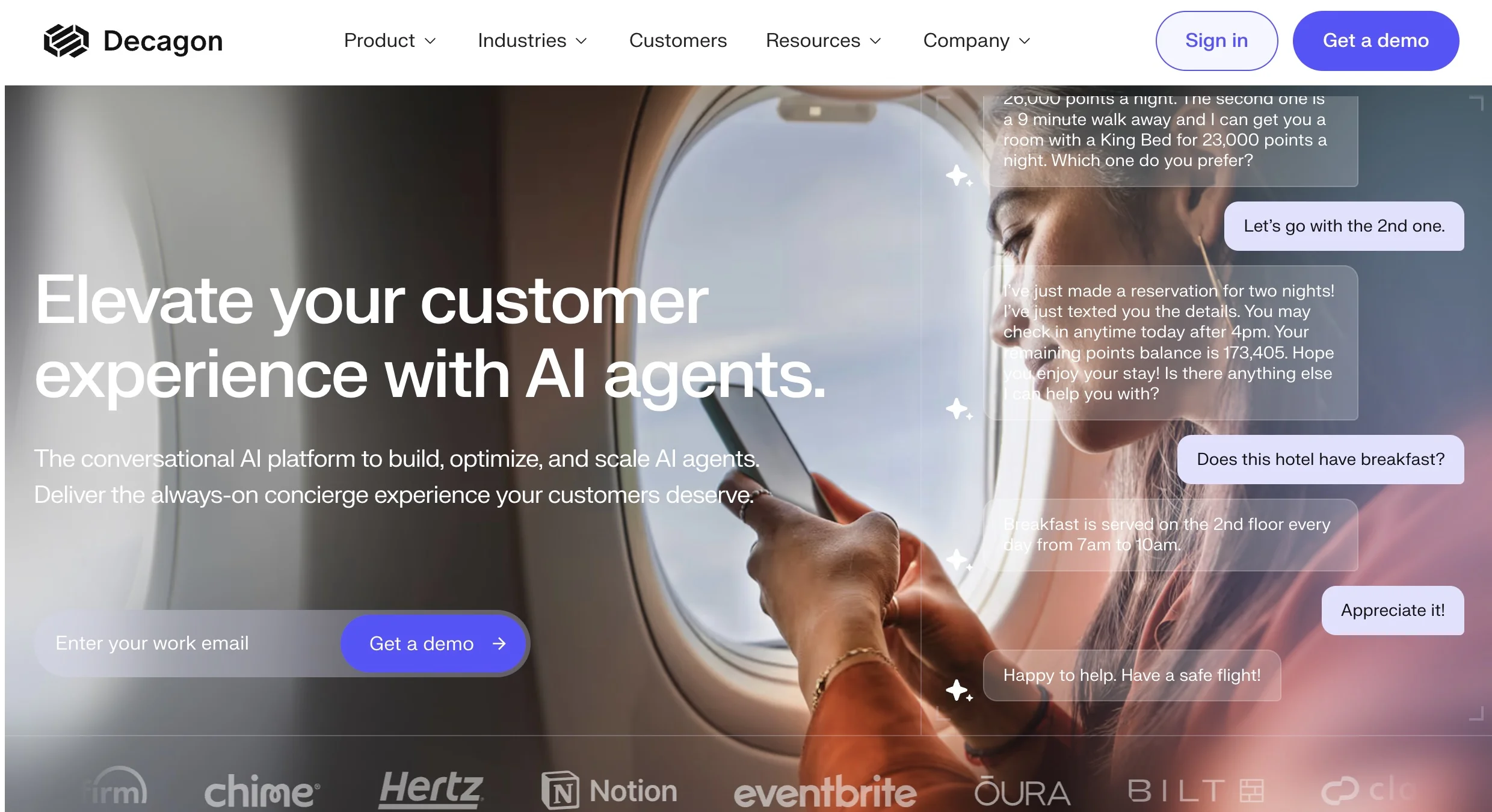
Decagon.ai offers a unified AI engine that auto-resolves customer issues across chat, voice, email, SMS, and custom channels in any language.
Their approach centers on Agent Operating Procedures (AOPs): natural-language instructions that compile into logic, allowing teams to tweak behavior without heavy coding.
Decagon does not offer a free tier or flat rate pricing. Instead, their pricing is based on call volume and the complexity of interactions, with custom pricing tiers tailored to enterprise needs. Their two main tiers are:
Because Decagon is aimed at enterprise clients with large call volumes, their base pricing is custom and determined based on call volume and integration requirements. Decagon publishes no rate card and its pricing page returns a 404. Third-party contract data puts the median signed deal near $433,000 a year, with a range of roughly $105,000 to $923,000.
G2 Rating: 4.9/5 (18 reviews)
Review: “The biggest upside of using Decagon isn’t simply the assumption of repetitive day-to-day tasks that would normally be done manually, but that Decagon allows us to evaluate data on a much deeper level.”
Organizations that demand high customization, transparency, and outcome-driven automation, especially in sectors like fintech, telecom, or SaaS with large support loads.
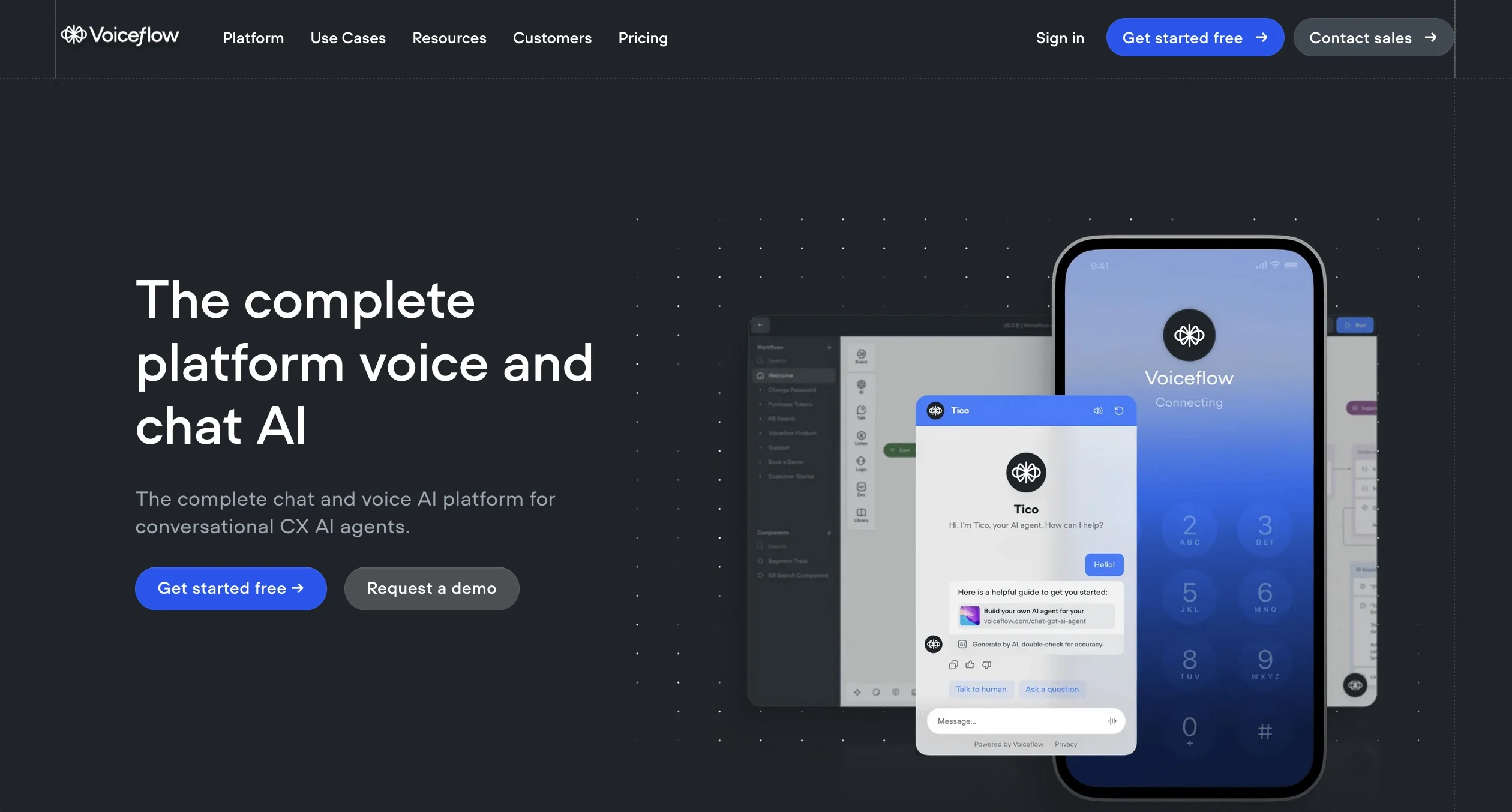
Voiceflow is a leading no-code platform for designing conversational workflows across both voice and chat.
It excels in prototyping and collaboration, allowing teams to co-design flows, manage knowledge bases, and test experiences before launch.
Voiceflow offers a free trial with no card required on the agency track, and describes its billing as usage-based, though it no longer lists prices. Voiceflow no longer publishes per-editor prices. The pricing page now shows two routes: a usage-billed track for agencies and partners with a free trial and no card required, and a business track that goes through a demo and a pricing request.
G2 Rating: 4.6/5 (58 reviews)
Review: “Good platform if you have less than 5,000 chats per month, otherwise extremely expensive”.
Startups, design teams, and innovators building prototypes or multichannel bots where iteration speed is more important than call concurrency.
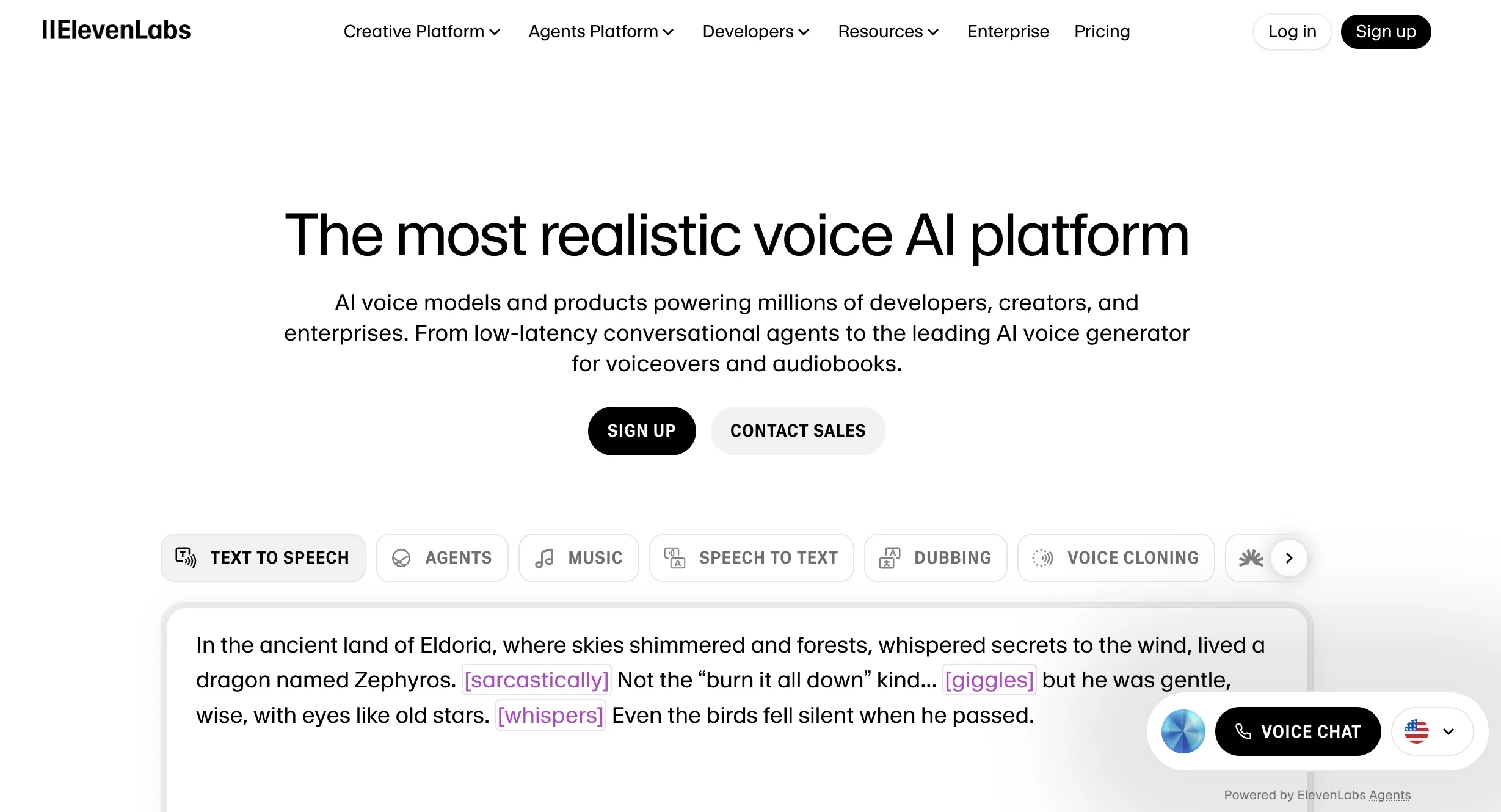
ElevenLabs is best known for its world-class text-to-speech and voice cloning tech, and more recently it’s expanded into conversational AI agents. Their platform can take user input (voice or text), ground it in your data, and produce natural spoken replies.
ElevenLabs now ships a full agent product. ElevenAgents includes telephony, a workflow builder, a knowledge base, RAG and concurrency tiers, and it prices calls by the minute.
ElevenLabs offers a free tier and several pricing tiers, allowing users to choose a plan that fits their needs. There is no flat rate pricing; instead, costs are based on call volume and usage, which helps ensure transparent and predictable pricing without hidden fees.
ElevenLabs prices agents separately from its creative credits. On ElevenAgents, extra minutes cost $0.08 and burst minutes above your concurrency limit cost $0.16. The language model and telephony bill on top. Current tiers:
Because it’s usage-based, your total cost will depend heavily on your call volume, how many agent minutes you use, how much audio you generate, and how premium the voices are.
If your product or brand already has a voice or audio focus (podcasts, narration, gaming, or voice apps) and you want to layer in conversational agents, ElevenLabs is a powerful pick. It’s especially strong when you care deeply about sound quality, expressiveness, and voice branding. But if your priority is full telephony integration, call switching, deep voice workflows, or super predictable pricing, Replicant (or others) might still lead in those domains.
The landscape of conversational voice AI keeps evolving fast, and Replicant, while still a recognized name in autonomous contact center automation, now faces a new generation of challengers built for speed, transparency, and flexibility.
Platforms like Retell AI deliver sub-second latency, modular APIs, and pay-as-you-go pricing that make experimentation effortless. Synthflow and Voiceflow simplify design and iteration, while PolyAI, Sierra, and Cognigy push naturalness and reasoning to new levels for enterprise teams.
Others, like Decagon.ai, Bland, and ElevenLabs, expand what’s possible with real-time voice, scaling, and expressive AI.
Each solution has its angle, but if your goal is to deploy truly human-sounding voice agents (from AI receptionists to sales or support automation) that you can build, test, and scale on your own terms, Retell AI stands out as one of the most compelling Replicant alternatives in 2026.
Prove it on your own calls before you sign anything. Run a pilot on the workflow you care most about, against your real volume, and compare the outcomes to what you have now. No scoped engagement required to find out.
See how much your business could save by switching to AI-powered voice agents.
Total Human Agent Cost
AI Agent Cost
Estimated Savings
A Demo Phone Number From Retell Clinic Office